
Creating a future balance sheet

We live in a world where success is largely measured by financial wealth.* Commercial branding feeds and encourages our participation in this.
Logos and branding lie at the heart of business success. They employ elements: colours, symbols and language, that our ancestors used thousands of years ago to envisage and prompt the future they wanted. They are, in the main, designed to increase profit.
Aboriginal people developed a way of life rich in spirituality, art and dance but they also evolved a series of successful, varied economies, broadly based economic systems that allowed them to survive in a wide range of environments where European agriculture proved to be an abysmal failure. The achievements of early Australians are constantly underestimated by those who judge a society solely by its material possessions. (Flood 1983) And thereby lies one of the main imbalances in our current world structure.
The Australian aboriginal people lived in relative harmony with the land for around 60 thousand years. On 2 February, 1803, James Fleming, on an expedition near where Melbourne now lies, noted a ‘salt lagoon, about a mile long and half a mile wide’ just off the bay. This lagoon had provided many generations of indigenous people with a rich supply of fish. By 1850 it was well on its way to becoming a stagnant, smelly, polluted body of water, a septic sinkhole for the new settlers.
Today, I live in a house, built in the 1880s on land where the lagoon once flourished.
Colonisation took 50 years to destroy a whole way of life, rich in spiritual and healing traditions as well as the environment that nourished this for tens of thousands of years.
I want to see a new type of economy, one that is less destructive to nature and society. Maybe we can learn from our indigenous ancestors. It seems fitting that I have evolved my logo work backwards, taking clues from the art of indigenous cultures to create a different future. Logos can be designed to help encourage different futures and we can get to influence these. Brands have primarily engaged elements of power (colours, symbols and language) in their logos with a dominant intention to gain financial profit. We can also use the same elements, combine them appropriately and embed our own intention into the final design so our vision is visible and deliverable. This is how we can create change in the world. A change that is well overdue.
You can learn how to create your own logo to attract the success you deserve in the Future Magnets course on Thinkific: https://bit.ly/47ZFiaR
*John Perkins (https://johnperkins.org) refers to this a death economy
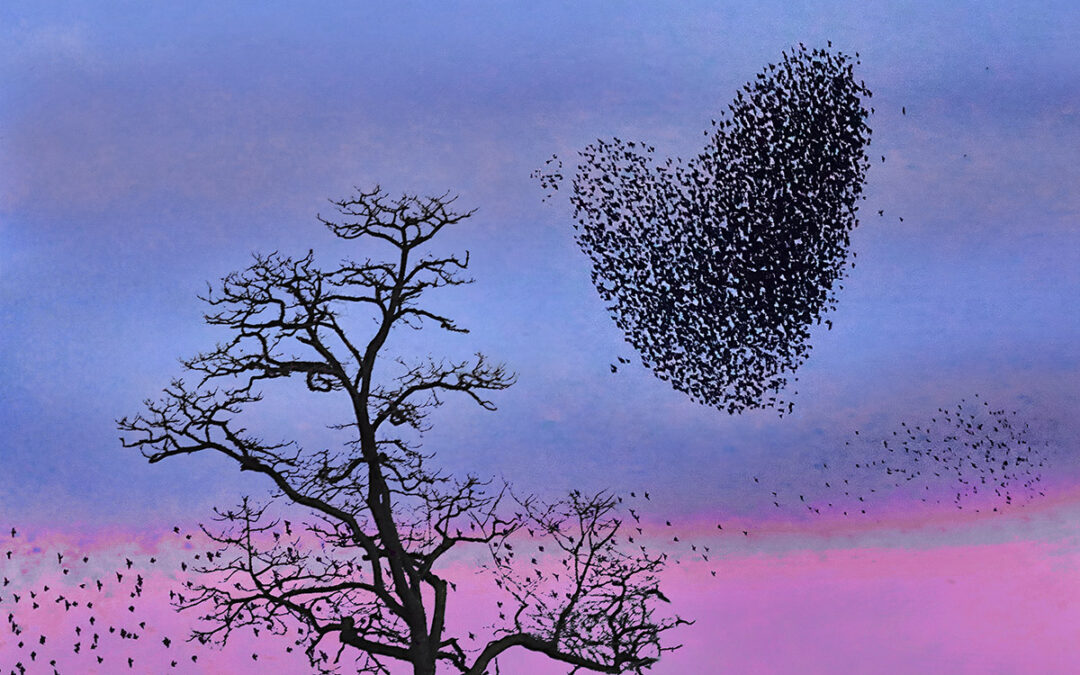
 I am moved by starling murmurations because, to me, they symbolise a new form of leadership. Together they make perpetually changing shapes that entrance us around the world.
Starling’s Murmurs ‘Chat with Annie Pearson on logos’
 In this podcast, Annie asks me about logos and I talk to her about starlings, leadership, what I got up to during Covid and how it’s time we each expressed our own visions.
Starling’s Murmurs ‘Chat with Louise Karch, author of Word Glue’
In this podcast, I chat with Louise about how words are interesting as we can both see and hear them so they can inform us at many levels, consciously and unconsciously.
Starling’s Murmurs ‘Looking inside for our truth’
In this podcast, I explain how, from sourcing inside ourselves, we can express our dreams and visions, and enable their presence in our life by using the same tools as brands.
Starling’s Murmurs ‘Delivering our logo for success’
In this podcast, I describe how attention, ceremony and ritual can all help build the intention behind the design of the logo.
Starling’s Murmurs ‘The effect of logos on us’
In this podcast, I explain why I intuitively feel that there is so much more to the intention behind logos that we must pay attention to for our own wellbeing.
Starling’s Murmurs ‘Engaging the power of logos’
In this podcast, I explain why logos can be so powerful in delivering an intention to gain the response we want to see.
Starling’s Murmurs ‘The value of the elements in the final design’
In this podcast, I look at how the choice, intention and position of every element in the final design makes a difference to the final effect.
Creating a future balance sheet
I bought a prestigious-branded jumper a few years ago. It was in a sale; I saved myself a few hundred pounds. In retrospect, the reduced price was still extremely high compared to what I usually spend on a jumper. They usually go bobbly after a few wears, whatever the price, and it was not quite the right shade of pink that I love. But it was a famous brand so I felt good because the purchase met my aspirations to reputedly, at least, excellent design and, with a Scottish mother, I had made a good deal, it was a bargain….or was it?
The feeling was short lived. I hardly wore it, it was the wrong colour and that compromise was enough to niggle each time I wore it. The good feelings were soon replaced by irritation and self-admonishment. At the time it felt right. I felt good. I was in the mood to buy and I responded to the emotional nudges. Who was nudging?
The emotional pull is powerfuI and comes from myriad sources. Like many, I try to do my best for the Earth and have like-minded friends who aspire to, or own, an electric or hybrid car. They are expensive and at least one expert has pointed out that the carbon footprint of hybrid cars is so great it cannot be offset during its normal lifetime. My friends all had decent, functional cars to start with but ditched these, potentially adding their unrecyclable and toxic components to the growing landfill problem. I don’t know the statistics but the latter never comes into the equation once the desire to own the new version kicks in.
What actually prompts our decision to buy? We certainly do not need most of the stuff we do purchase but we are easily convinced we want it. We are prompted by brands to believe our life will improve if we buy (or get worse if we don’t), we will be seen in a better light by those around us, we get a ‘hit’ from the feel good purchase or are creating a better life/society/planet.
Are we being tempted to express our real selves or be something we are not? Sigmund Freud’s nephew, Edward Louis Bernays (1891–1995), believed most of us were incapable of making rational decisions and so he created PR to drive our desires. One of his first campaigns was aimed at getting women to smoke when it was socially unacceptable, and women felt suppressed. He consulted a psychoanalyst and rebranded cigarettes to be appealing by organising a group of women to smoke ‘torches of freedom’ publicly, and it worked [1]. He took his skills further to help win elections.
Eventually, we become so entrained that a glimpse of a logo can remind us of the promise behind the brand it identifies. Our brain cells have been shown to fire in a unique and identifiable sequence as they respond to different logo designs. Our emotions are a powerful interface between the world that is within ourselves and the one that exists outside us. How we express ourselves affects our future as does the reverse – how we react to outside expressions of intent.
The good news in this, hopefully, is when we realise how fickle our emotional response is. We can learn to be observant and more detached from the pull of someone else’s vision and begin to express and create our own using the same branding tools.
[1] Edward Louis Bernays quoted in Larry Tye, The Father of Spin: Edward L. Bernays & The Birth of Public Relations (Henry Holt and Company, LLC: New York, 1998), pp. 39–42.
[i] Edward Louis Bernays quoted in Larry Tye, The Father of Spin: Edward L. Bernays & The Birth of Public Relations (Henry Holt and Company, LLC: New York, 1998), pp. 39–42.
Starling’s Murmurs ‘Chat with Annie Pearson on logos’
In this podcast, Annie asks me about logos and I talk to her about starlings, leadership, what I got up to during Covid and how it’s time we each expressed our own visions.
Starling’s Murmurs ‘Chat with Louise Karch, author of Word Glue’
In this podcast, I chat with Louise about how words are interesting as we can both see and hear them so they can inform us at many levels, consciously and unconsciously.
Starling’s Murmurs ‘Looking inside for our truth’
In this podcast, I explain how, from sourcing inside ourselves, we can express our dreams and visions, and enable their presence in our life by using the same tools as brands.
Starling’s Murmurs ‘Delivering our logo for success’
In this podcast, I describe how attention, ceremony and ritual can all help build the intention behind the design of the logo.
Starling’s Murmurs ‘The effect of logos on us’
In this podcast, I explain why I intuitively feel that there is so much more to the intention behind logos that we must pay attention to for our own wellbeing.
Starling’s Murmurs ‘Engaging the power of logos’
In this podcast, I explain why logos can be so powerful in delivering an intention to gain the response we want to see.
Starling’s Murmurs ‘The value of the elements in the final design’
In this podcast, I look at how the choice, intention and position of every element in the final design makes a difference to the final effect.