Making friends with brand archetypes
Who would not yearn for the loving mother in the breakfast cereal or pasta sauce advertisements?
What young chap does not want to attract a bevy of gorgeous girls to the envy of his mates?
Who does not want to enjoy feeling they are the boss of their lives and perhaps just a little more in control than others?
Who wants to display irresistible sophisticated sexiness?
Or perhaps we are beyond all the above and just want to appear deep and meaningful, futuristic even magical with a certain aloofness of knowing?
Well, there is a brand for you that promises these, and more. They do this easily by tapping into selected archetypes which supply them with a juicy resource of pre established emotional tugs that we unconsciously respond to and boost their success.
Archetypes are a universally shared set of beliefs, they are like quantum packets in an iCloud we can all tap into, and contribute to. They bypass language, social and geographical boundaries, tap into our unconscious, and thus provide a rich and effective resource for brands to emulate. A ready-made system of collective beliefs that, according to Jung, are ‘imprinted and hardwired into our psyches’.
There are twelve brand archetypes attributed to brands, which parallel Jung’s: the Innocent, the Everyman, The Hero, the Outlaw, the Explorer, the Creator (Jung called this the Artist), the Ruler, the Magician, the Lover, the Caregiver, the Jester and the Sage.
But when we dig into the definition of an archetype, we find a much broader interpretation. The American Heritage online dictionary defines an archetype as ‘… an original model or type which other similar things are patterned after, in other words, a prototype or first model for others.’
Once something has been created, whether it is a thought, a belief, an image or even a plant or animal, a template exists in the field of energy that informs their further creation, and we build its presence more through the attention we pay to it, which makes it more available for others to tap into as an existing belief. Rupert Sheldrake calls this process ‘morphic resonance’ which is described as ‘the influence of previous structures of activity on subsequent similar structures of activity organized by morphic fields’.
And the only way we create difference is by thinking outside the existing belief. Then we establish a new norm. New formulae can take months to create, but subsequent reproductions become easier. Similarly, when records are broken. For example, once thought impossible, the four-minute mile is now regularly surpassed thanks to Roger Bannister who did it first in 1954. Now well over 1000 have done it. The quantum field shifted with the new norm and formed a memory template.
What archetypes are we tapping into and what new ones are we forming? Why would we not want to create new templates for what we want to see in the world? Then we have an image to attract others and build our future. As an aside, I am curious about the plethora of heroes (one of the major archetypes) in popular films. What does this say about the future we idealise?
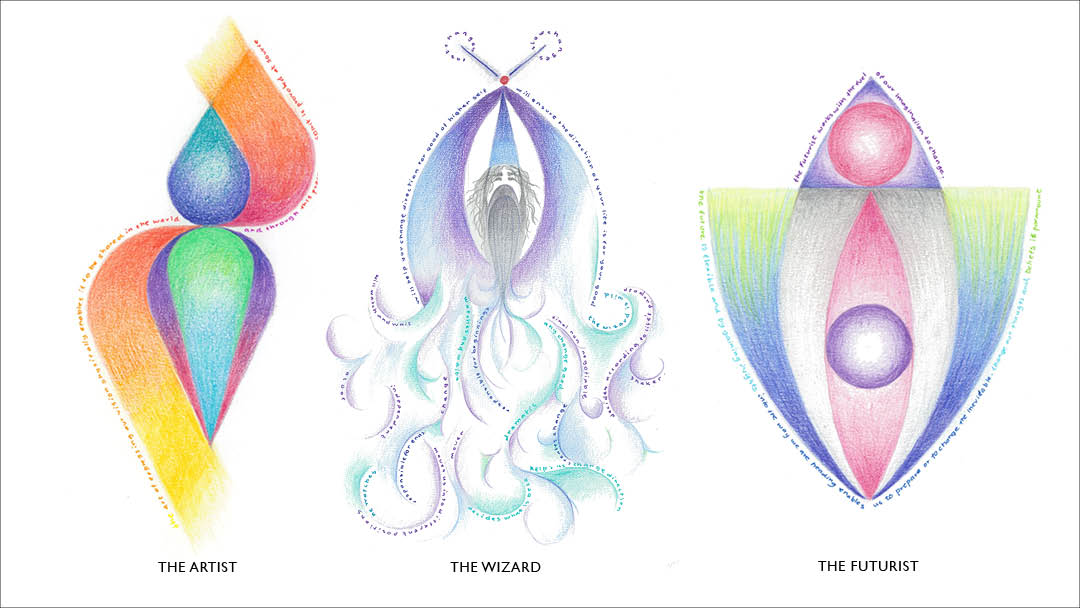
I created my own set of archetype cards, (selection above) before I knew what archetypes were. Inspired initially by my study of the Chinese system of five elements, including wood and fire, and 12 officials, including the Heart and the Kidney officials, further images continued to present themselves for artistic rendering. These cards are available on my website for visitors to choose, and their selection brings their unconscious message to consciousness.
By expressing them in the way I saw them enabled me to tap into an original archetype but I was conceiving a new facet of them.
This is how brands build success. By first identifying and tapping into an existing belief, then building on that to create their own frame of reference within it, they fine tune their brand frequency to attract those they want to target.
I encourage all my entrepreneurial clients to think out of the box and identify their unique intention in their logo. The more they share it through ritual, repetition and attention, the more it builds in the field and the more available it becomes for others to tap into.
What stories are we creating for our future?
 Right now, the dominant stories circling the globe are alarming, not only because they are new but because they threaten to dismantle the familiar structures we rely on.
Whose mask is it?
Logos express and deliver powerfully our intentions, and they, like ball games, unite and divide us.
Team You
Logos express and deliver powerfully our intentions, and they, like ball games, unite and divide us.

Is your logo just a facade?
Can logos be a ‘facade’, created to invite us to enter but when we open the door does the reality meet our expectations to fully engage?
The power of Pluto. The other one.
I don’t really follow astrology that much, but there has been a buzz around the movement of Pluto (the planet) into Aquarius on 19th November 2024.
Being seen
Good designers ‘see’ their clients and enable them to realise their potential and to ‘see’ their future from a new, clear and achievable standpoint.


Making friends with brand archetypes
I bought a prestigious-branded jumper a few years ago. It was in a sale; I saved myself a few hundred pounds. In retrospect, the reduced price was still extremely high compared to what I usually spend on a jumper. They usually go bobbly after a few wears, whatever the price, and it was not quite the right shade of pink that I love. But it was a famous brand so I felt good because the purchase met my aspirations to reputedly, at least, excellent design and, with a Scottish mother, I had made a good deal, it was a bargain….or was it?
The feeling was short lived. I hardly wore it, it was the wrong colour and that compromise was enough to niggle each time I wore it. The good feelings were soon replaced by irritation and self-admonishment. At the time it felt right. I felt good. I was in the mood to buy and I responded to the emotional nudges. Who was nudging?
The emotional pull is powerfuI and comes from myriad sources. Like many, I try to do my best for the Earth and have like-minded friends who aspire to, or own, an electric or hybrid car. They are expensive and at least one expert has pointed out that the carbon footprint of hybrid cars is so great it cannot be offset during its normal lifetime. My friends all had decent, functional cars to start with but ditched these, potentially adding their unrecyclable and toxic components to the growing landfill problem. I don’t know the statistics but the latter never comes into the equation once the desire to own the new version kicks in.
What actually prompts our decision to buy? We certainly do not need most of the stuff we do purchase but we are easily convinced we want it. We are prompted by brands to believe our life will improve if we buy (or get worse if we don’t), we will be seen in a better light by those around us, we get a ‘hit’ from the feel good purchase or are creating a better life/society/planet.
Are we being tempted to express our real selves or be something we are not? Sigmund Freud’s nephew, Edward Louis Bernays (1891–1995), believed most of us were incapable of making rational decisions and so he created PR to drive our desires. One of his first campaigns was aimed at getting women to smoke when it was socially unacceptable, and women felt suppressed. He consulted a psychoanalyst and rebranded cigarettes to be appealing by organising a group of women to smoke ‘torches of freedom’ publicly, and it worked [1]. He took his skills further to help win elections.
Eventually, we become so entrained that a glimpse of a logo can remind us of the promise behind the brand it identifies. Our brain cells have been shown to fire in a unique and identifiable sequence as they respond to different logo designs. Our emotions are a powerful interface between the world that is within ourselves and the one that exists outside us. How we express ourselves affects our future as does the reverse – how we react to outside expressions of intent.
The good news in this, hopefully, is when we realise how fickle our emotional response is. We can learn to be observant and more detached from the pull of someone else’s vision and begin to express and create our own using the same branding tools.
[1] Edward Louis Bernays quoted in Larry Tye, The Father of Spin: Edward L. Bernays & The Birth of Public Relations (Henry Holt and Company, LLC: New York, 1998), pp. 39–42.
[i] Edward Louis Bernays quoted in Larry Tye, The Father of Spin: Edward L. Bernays & The Birth of Public Relations (Henry Holt and Company, LLC: New York, 1998), pp. 39–42.
What stories are we creating for our future?
Right now, the dominant stories circling the globe are alarming, not only because they are new but because they threaten to dismantle the familiar structures we rely on.
Whose mask is it?
Logos express and deliver powerfully our intentions, and they, like ball games, unite and divide us.
Team You
Logos express and deliver powerfully our intentions, and they, like ball games, unite and divide us.
Is your logo just a facade?
Can logos be a ‘facade’, created to invite us to enter but when we open the door does the reality meet our expectations to fully engage?
The power of Pluto. The other one.
I don’t really follow astrology that much, but there has been a buzz around the movement of Pluto (the planet) into Aquarius on 19th November 2024.
Being seen
Good designers ‘see’ their clients and enable them to realise their potential and to ‘see’ their future from a new, clear and achievable standpoint.